Home › Why it's wet
Work it out before you pay for it
Why Is My Basement Wet? A Schenectady Guide
Basement water comes from one of five places, and you can usually identify which from the floor without tools. This walks through telling them apart, what each costs to fix, and which you can handle yourself this weekend.
(518) 617-4320Free advice on the phone whether or not it turns into a job.
- The five sources
- Condensation or seepage?
- Read the location
- Read the calendar
- Why here, specifically
- What to do now
- Questions
The five sources
Everything that wets a basement floor falls into one of these. Different causes, different fixes, prices two orders of magnitude apart — which is exactly why guessing is expensive.
1. Surface water
Roof runoff and rain landing beside the house, then soaking down along the foundation. Most common cause, cheapest fix. Gutters, downspouts, grading.
2. Hydrostatic pressure
The water table rises above your slab and pushes up. Water appears at the cove joint or through the floor with no crack in sight.
3. Wall seepage
Through a defined crack in a poured wall, through mortar joints in block, or across the whole face of a rubble wall.
4. Condensation
Humid summer air meeting cold masonry. Feels exactly like a leak and isn't one. Fixed with a dehumidifier, not a drainage system.
5. Plumbing
A weeping supply line, failed water heater, condensate pump, washing machine hose. Always check before assuming groundwater.
— and the outlier
Overland flooding from the Mohawk. Not a foundation problem at all, and a genuinely separate category here. Covered separately.
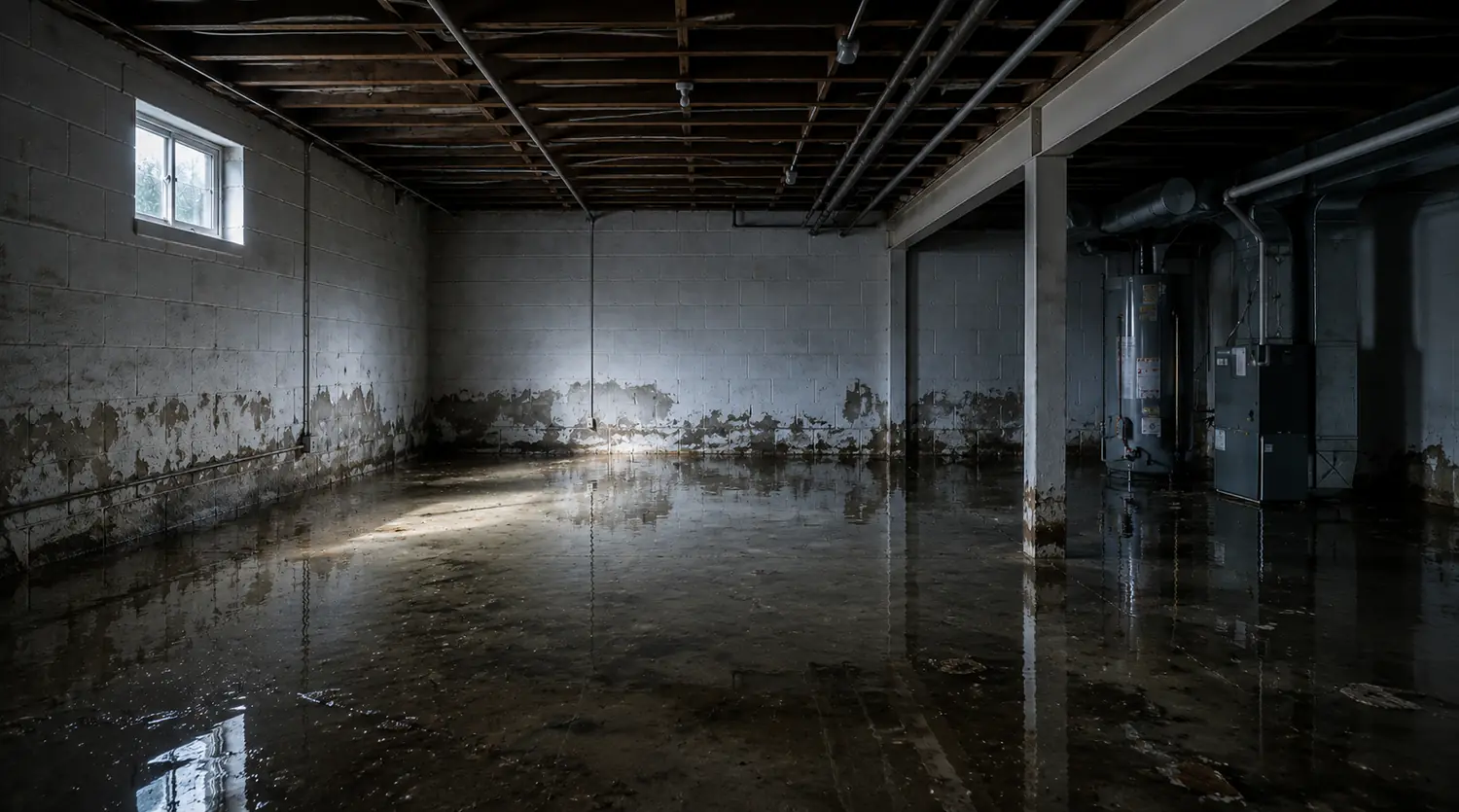
Describe what you're seeing and we'll tell you which of the five it is, free. Call (518) 617-4320.
Condensation or seepage? Settle it in a day
Do this first, because one fix is a $300 dehumidifier and the other can be $9,000. There's a definitive test and it takes 24 hours.
The foil test. Tape a one-foot square of aluminum foil tightly to the damp area, sealing all four edges with duct tape. Leave it 24 to 48 hours, then pull it off.
Water on the room side means humid air is condensing on cold masonry. Ventilation and dehumidification.
Water on the wall side means moisture is coming through the wall. Seepage, and it needs drainage.
Condensation here is strongly seasonal — it appears in July and August when warm humid air meets a wall still sitting in the fifties, and disappears in winter. Damp in August and dry in February is almost certainly a humidity problem. The reverse pattern is the one that needs drainage.
Read the location
| Where it appears | Most likely cause | Typical fix |
|---|---|---|
| Along the floor-wall seam, all the way round | Hydrostatic pressure | Interior perimeter drain, $4,200–$12,000 |
| One corner only, always the same one | Downspout or grade at that corner | Extensions and regrading, $150–$2,600 |
| A vertical line down a poured wall | Shrinkage crack | Injection, $400–$950 |
| Across the whole face of a stone wall | Failed mortar joints | Repointing plus drainage |
| Middle of the floor, no crack visible | Water table above slab level | Interior drain and sump |
| Under a window, in the well | Window well filling | Well drain and cover, $300–$950 |
| High on the wall near the sill | Grade above the foundation top, or gutter overflow | Regrading, gutter repair |
| Everywhere evenly, in humid weather | Condensation | Dehumidifier, $1,200–$2,700 |
Read the calendar
When it happens narrows it further, and in this climate the calendar is unusually informative.
- During rain, stopping within hours. Surface water. Look up before you look down.
- A day or two after heavy rain, lingering for days. Groundwater responding slowly. Points to hydrostatic pressure.
- Every year at the thaw, reliably. The signature pattern here. Meltwater can't soak into frozen ground, so it runs across the surface and down the foundation.
- Only in July and August. Condensation.
- All the time regardless of weather. Plumbing, a spring under the house, or a chronically high water table. Check plumbing first — cheaper to be wrong about.
- Suddenly, after twenty dry years. Something changed. Someone next door regraded, the town altered a drainage run, a gutter separated at a seam, or the pump gave out without anyone noticing. Check the pump first.
Why this happens so much here
Four factors stack, and they compound.
The houses are old. Around half of Schenectady's housing stock predates 1939. The Stockade holds over four hundred homes more than two centuries old; the GE Realty Plot went up between 1887 and 1939. Foundations from those eras are rubble or early block, with no footing drain, no exterior damp-proofing, and often barely a footing. They were built to breathe, not to stay dry. More on that here.
The freeze-thaw cycle is relentless. A frost line of 42 to 48 inches means soil against the upper foundation freezes and expands dozens of times each winter. That movement opens hairline cracks into real ones, works mortar out of stone joints, and slowly tips grading back toward the house.
Winter arrives all at once in reverse. Around sixty inches of snow accumulates through the season, then melts onto ground still frozen and unable to absorb any of it. That is the single wettest moment of a Capital Region basement's year, and it's why our busiest stretch is February through April rather than midsummer.
And the river participates. When the Mohawk runs high or jams with ice, groundwater across low-lying neighborhoods rises with it — affecting houses several streets back from the bank, not just those on it.
What to do right now, in order
- Safety first. Standing water and electricity don't mix. If water is near outlets, the panel or a furnace, kill the circuit before wading in — and if you can't do that safely, call an electrician before anyone else.
- Check the sump pump. Lift the float by hand. If it doesn't run, that may be your entire problem.
- Rule out plumbing. Water heater base, supply lines, washer hoses, condensate line. A five-minute check that occasionally saves five figures.
- Go outside during the rain. Genuinely. Overflowing gutters and downspouts at the wall are visible in thirty seconds and explain a large share of wet basements.
- Photograph it. Wet, and again dry. Note date and weather. Most useful thing you can hand a contractor.
- Do the cheap fixes first — extensions and grading — then wait one full wet season, meaning one thaw.
- Then get quotes, more than one, in writing, with the linear footage stated.
Questions people actually ask
Nothing is cracked, so why is water appearing along the base of the wall?
That's the cove joint — the seam where the slab meets the footing. Floor and wall are poured as separate elements and nothing ties them together, leaving an unbroken gap right around the room. When groundwater rises beneath the slab, that seam is the path of least resistance. It's the most common seepage point in an older basement and precisely what an interior perimeter drain addresses.
Will sealing the walls from inside fix it?
Not with pressure behind them. Coatings work against damp and vapor, not a head of water; under hydrostatic pressure they blister and peel, usually within a year or two. On a rubble wall it's worse than useless, because trapping moisture in the wall drives it into the stone and mortar. As a finish on a wall already drained, it's fine.
My neighbor has the same house and a dry basement. Why me?
Usually grading, gutters or a downspout — small differences with large effects. Sometimes a buried spring or an old field tile crossing one lot and not the other. Occasionally their previous owner had work done and never mentioned it. Identical houses genuinely do behave differently.
How urgent is this? Can it wait for spring?
Depends what it's doing. Occasional dampness on a bare floor can wait. Water reaching a furnace, water heater or panel cannot. Neither can anything structural — horizontal cracking or measurable bow gets looked at now, because that failure mode isn't gradual. And standing water beyond about 48 hours starts a mold problem you'll pay to remediate on top of everything else. Worth noting that around here, waiting for spring means waiting until the wettest moment of the year.
Does a dehumidifier fix a wet basement?
It fixes a damp one. It does nothing about liquid water, and running one in an actively seeping basement is an expensive way to make slightly drier air. Do the foil test above and you'll know which you have.